

Three Women. Three Different Faces. The Same Relationship.

There are two ways to tell the story of a failed relationship.
The first is the easy version.
"She was crazy."
"She was a narcissist."
"She ruined my life."
It's clean. It's simple. It lets you sleep at night.
The second version is much harder.
"Why did I keep choosing the same woman over and over?"
That question wrecked me.
______________________________________________________________________________
"The definition of insanity is doing the same thing over and over and expecting different results." We've all heard the quote.
I don't know if Einstein actually said it. At this point, I think Abraham Lincoln has probably been credited with it too.
But whether it's true or not, the message hit me like a freight train.
Because for nearly twenty years, I lived it.
Three serious relationships.
Three completely different women.
Three different backgrounds.
Three different personalities.
Three different stories.
Yet somehow...
The exact same ending.
At some point I had to stop asking, "Why do I keep finding narcissists?"
And start asking the much harder question.
"Why do narcissists keep finding me?"
That question changed my life.
The Word Everyone Loves to Throw Around
Let's get something out of the way.
The word narcissist has become one of the most abused words on the internet.
Today, every selfish ex is a narcissist.
Every bad breakup involved gaslighting.
Every disagreement is emotional abuse.
It's become relationship bingo.
The reality is far more complicated.
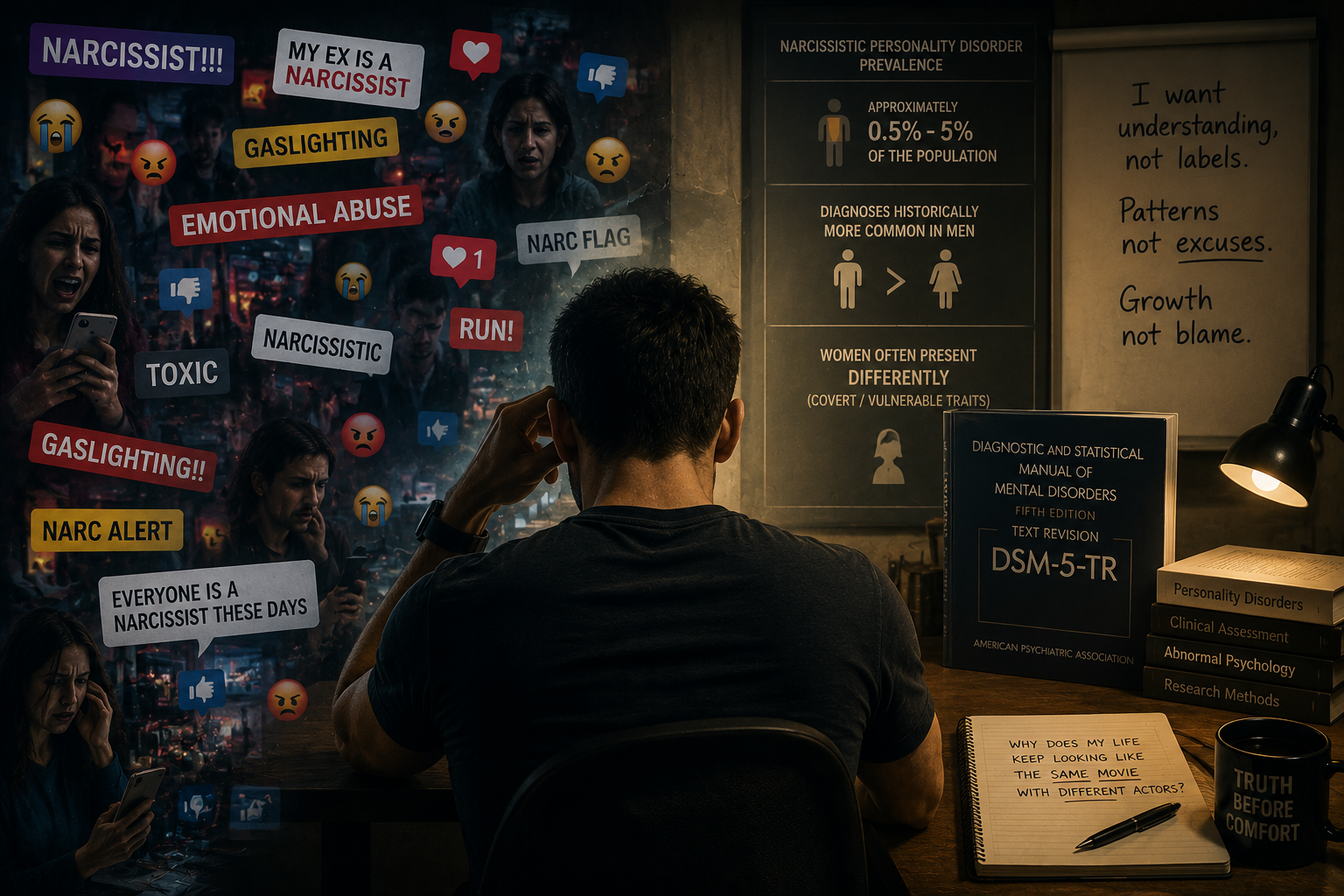
Clinical Narcissistic Personality Disorder (NPD) is a recognized mental health condition defined in the DSM-5-TR. Depending on the study, it affects somewhere between roughly 0.5% and 5% of the population. Historically, diagnoses have been more common in men, although researchers now recognize that women often present differently, particularly through more covert or vulnerable traits.
That's important.
Because I wasn't interested in internet psychology.
I wanted to understand the real thing.
Not because I wanted to diagnose people.
Because I wanted to understand why my life kept looking like the same movie with different actors.
Three Relationships. One Script.
After my last relationship ended, I started researching everything I could find.
Psychology.
Trauma.
Attachment theory.
The DSM.
Clinical journals.
Podcasts.
Books.
If there was a rabbit hole, I climbed into it.
What I discovered was unsettling.
While each woman was incredibly different on the surface, the relationship dynamics were nearly identical.
The beginning always felt incredible.
They admired me.
Needed me.
Made me feel like I was exactly the man they'd been praying for.
Looking back...
That should have been my first clue.
Healthy relationships usually grow slowly.
All 3 of mine exploded out of the gates like we both had desperately just discovered air.
Then, almost without warning...
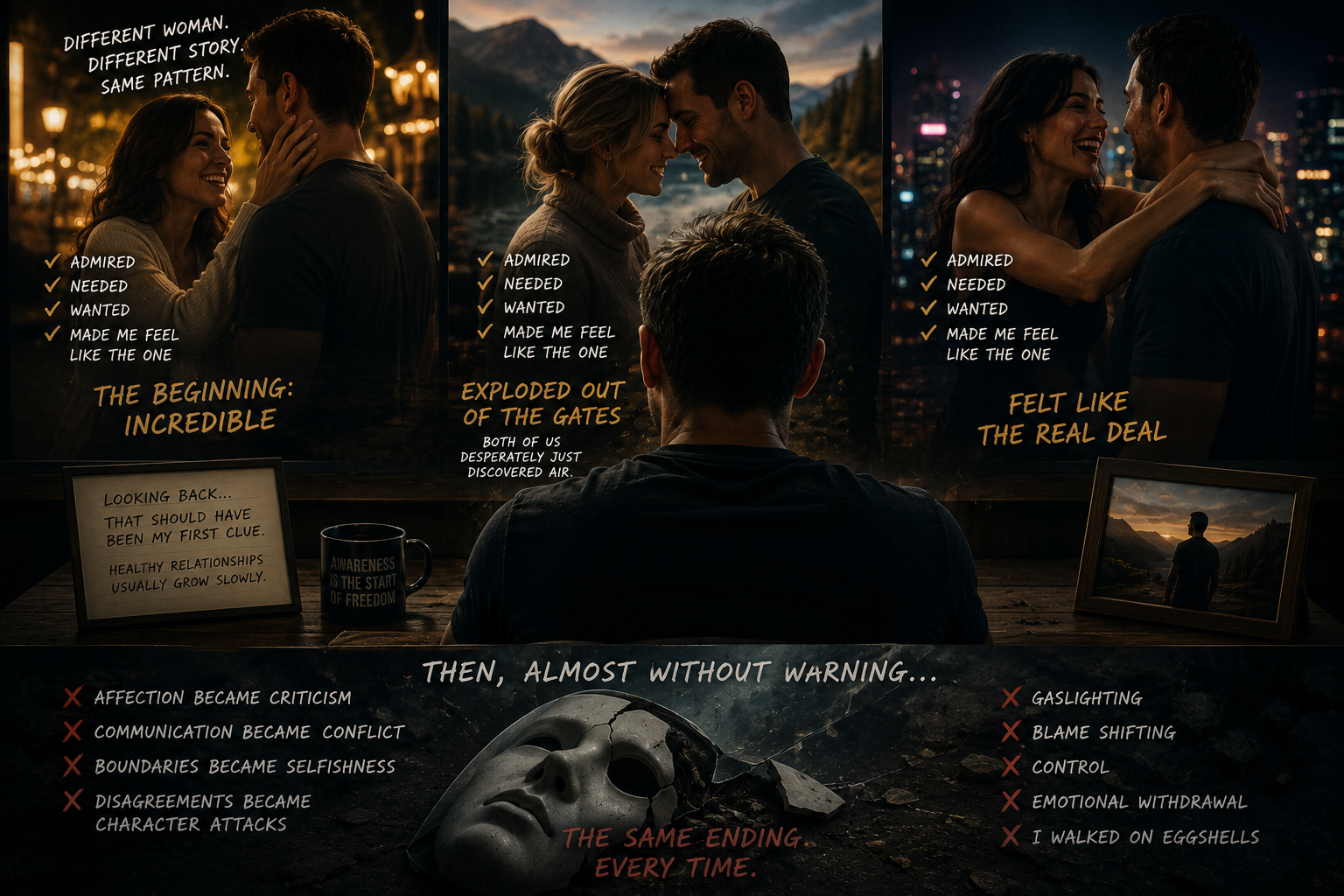
Everything changed.
Affection became criticism.
Communication became conflict.
Boundaries became selfishness.
Disagreements became character attacks.
I slowly found myself apologizing for things I hadn't done simply because it was easier than another argument.
I stopped asking what I needed.
I started asking what would keep the peace.
That's survival.
Not love.
I Did Something Most People Never Do
Instead of simply calling each woman a narcissist and moving on, I decided to compare their behaviors against the actual DSM-5 diagnostic criteria.
Not because I wanted to play psychologist. Well, maybe a little.
But because I wanted to see whether there really were patterns or whether my emotions were exaggerating my memories. I finally chose to look honestly in the mirror, examine both my circumstances and my own patterns, and do the difficult work of growing.
The DSM lists nine primary traits associated with Narcissistic Personality Disorder, with a diagnosis requiring a pervasive pattern that includes at least five of them and significantly impairs functioning.
So I made a chart.
I simply labeled my relationships A, B, and C.
Then I compared behaviors I had personally experienced.
Grandiosity.
Entitlement.
Lack of empathy.
Exploitation.
Need for admiration.
Envy.
Arrogance.
Fantasy.
Believing they were somehow unique or above others.
What surprised me wasn't any one relationship.
It was the consistency.
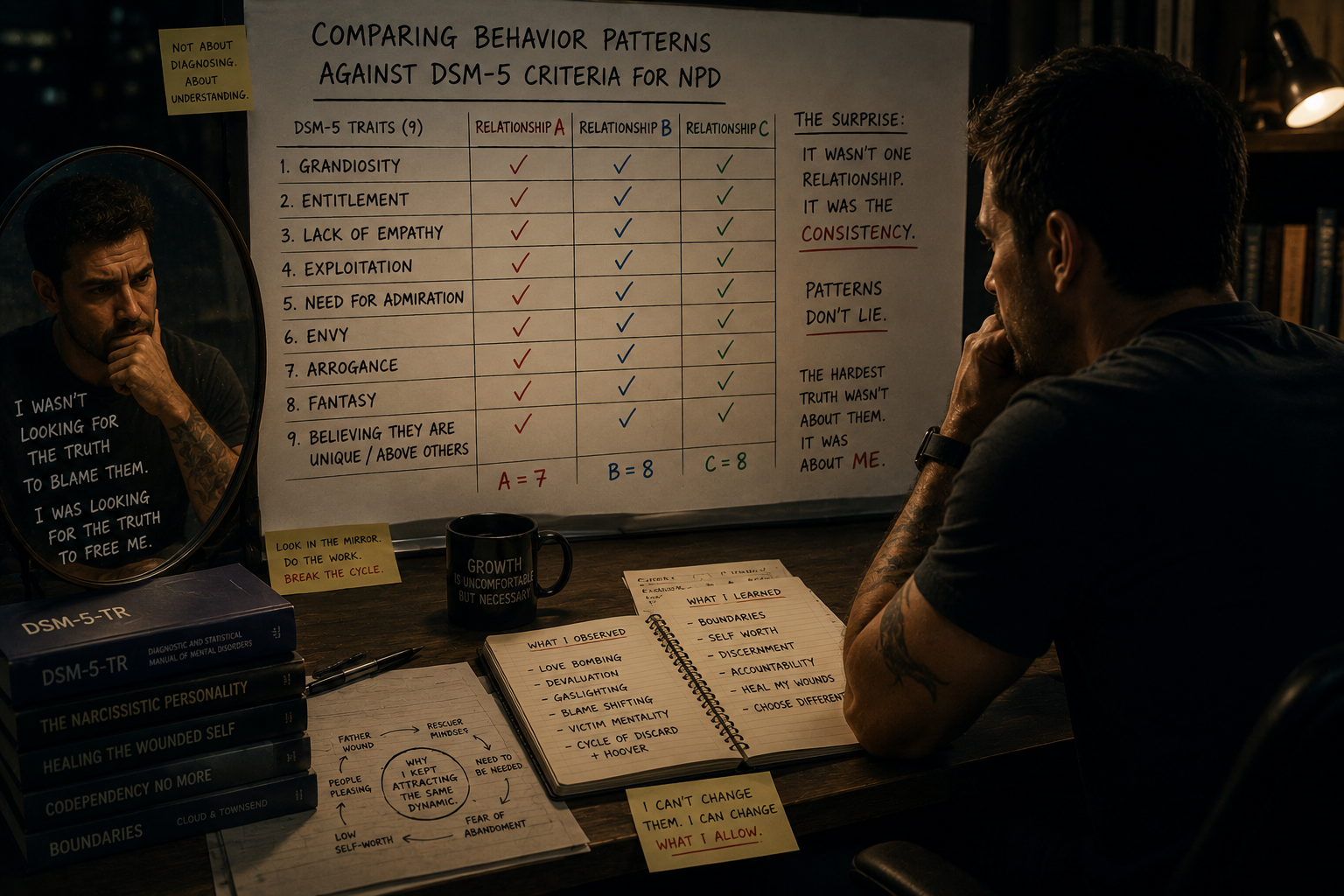
Relationship A reflected behaviors that aligned with seven of those traits.
Relationship B aligned with eight.
Relationship C also aligned with eight.
Again...
That doesn't mean I can diagnose anyone.
Only trained clinicians can do that.
But it was enough for me to stop dismissing my own experiences.
There were unmistakable patterns.
Not All Narcissism Looks the Same
One of the biggest misconceptions I had was assuming narcissists all look alike.
I pictured someone loud.
Cocky.
Boastful.
Always talking about themselves.
Turns out...
That's only one version.
Research describes several different presentations of narcissistic behavior, many of which are much harder to recognize.
One relationship was dominated by covert behaviors.
Victimhood.
Passive aggression.
Silent treatment.
Guilt.
She rarely yelled.
She simply made you feel guilty until you apologized.
Another leaned heavily into communal narcissism.
She wanted everyone to believe she was the most caring, selfless person in the room.
She loved helping...
As long as people noticed.
As long as they praised her.
As long as she remained the hero of the story.
Then there was the final relationship.
Everything was amplified.
Control.
Fear.
Intimidation.
Gaslighting.
It wasn't simply emotional conflict anymore.
It became emotional survival.
That's when I realized something.
I wasn't dating the same woman.
I was dating different expressions of the same unhealthy relationship dynamic.
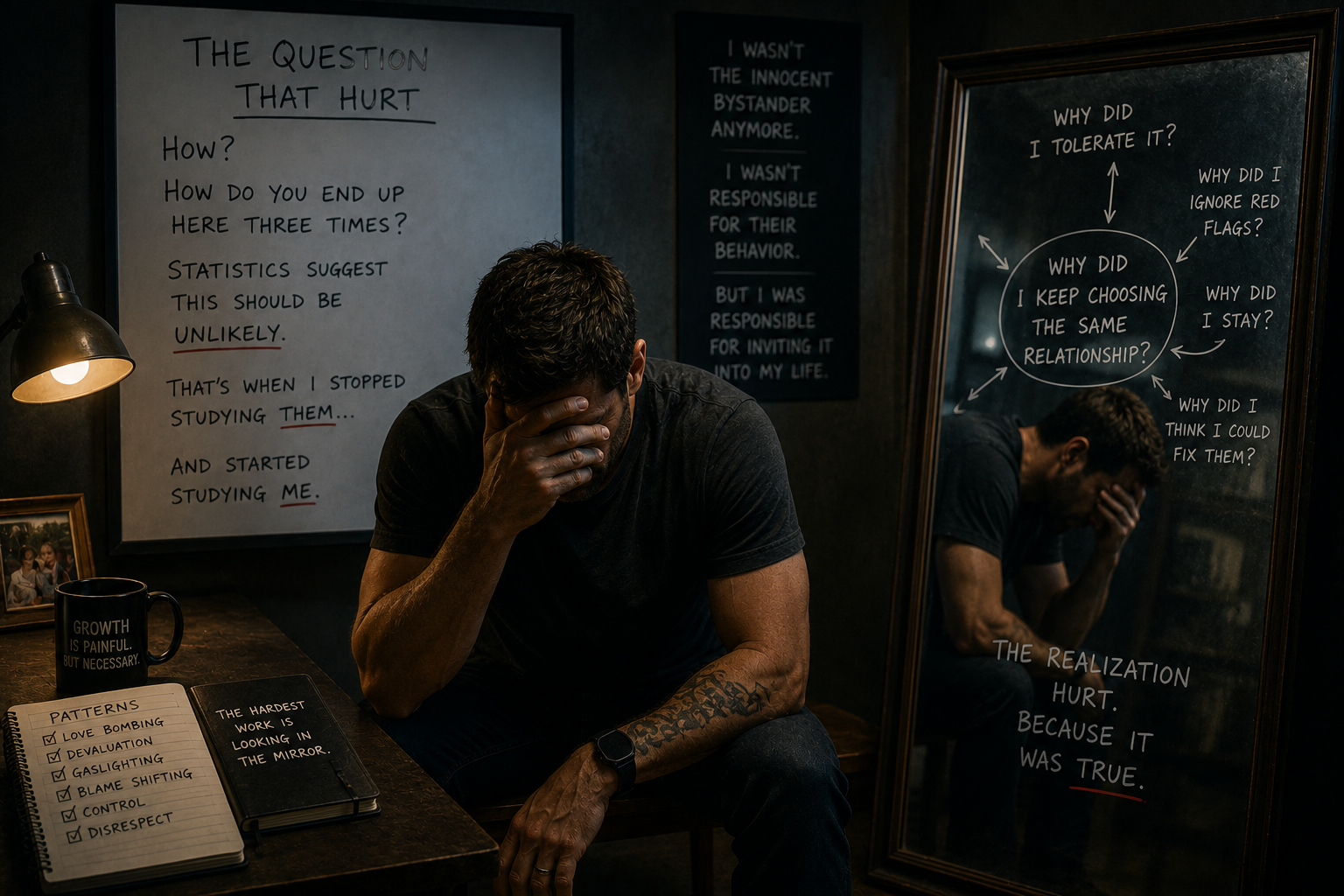
Then I Asked the Question That Hurt
How?
How do you end up here three times?
Statistics alone suggest that should be unlikely.
That's when I stopped studying them.
And started studying me.
That was infinitely more painful.
Because suddenly I wasn't the innocent bystander anymore.
I wasn't responsible for someone else's behavior.
But I absolutely was responsible for repeatedly inviting similar people into my life.
That realization hurt.
Because it was true.
I Was the Perfect Target
The research hit me like a punch in the gut.
Individuals with high empathy...
People-pleasers...
Rescuers...
Those who struggle with boundaries with those they care deeply for…
Those with unresolved childhood trauma...
Those desperate to find real love….
These are exactly the kinds of people manipulative personalities often gravitate toward.
I checked every box.
High empathy?
Absolutely.
Need to fix people?
Without question.
Forgive too easily?
Every single time.
Ignore red flags because "everyone deserves grace?"
That was practically my dating strategy.
Then I realized something even deeper.
Every one of those women came into my life needing something.
One needed rescued.
One needed stability.
One needed someone to fight for her.
And to a man who grew up feeling rejected by his own father...
Being needed felt incredible.
Because I confused being needed...
With being loved.
Those aren't the same thing.
Not even close.
My Father Was in Every Relationship
For years I blamed my relationships.
Eventually I realized...
My father had quietly been sitting in every one of them.
Not physically.
Emotionally.

Growing up with an emotionally unavailable, self-focused father teaches you dangerous lessons.
You learn that love is conditional.
You learn that approval must be earned.
You learn that maybe...
If you're just patient enough...
Helpful enough...
Selfless enough...
Someone will finally choose you.
So when someone entered my life broken...
I didn't see danger.
I saw purpose.
I thought love meant sacrificing myself.
I thought loyalty meant enduring anything.
I thought forgiveness meant removing boundaries.
I was wrong.
Then I Found Something I Never Expected
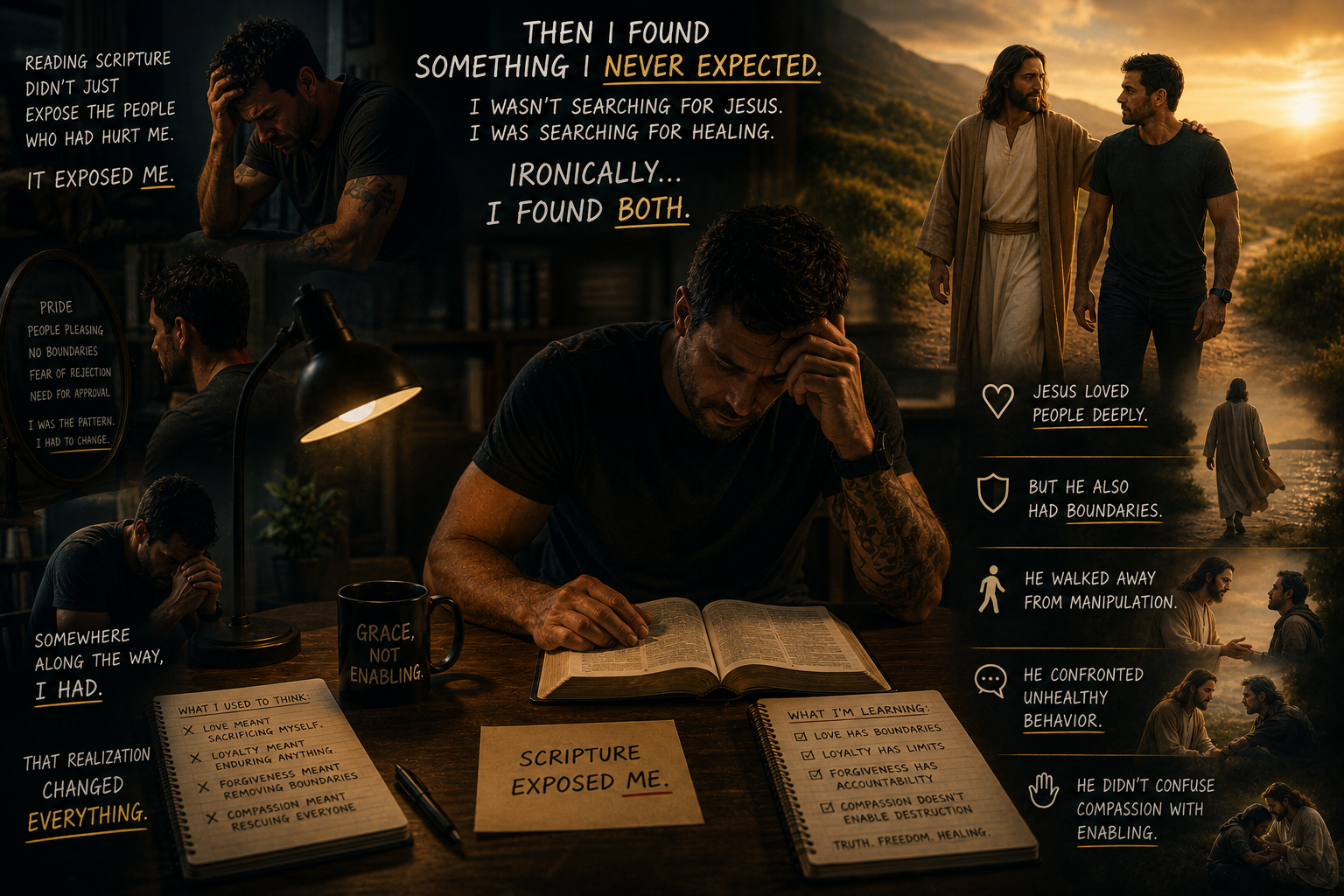
I wasn't searching for Jesus.
I was searching for healing.
Ironically...
I found both.
Reading Scripture didn't just expose the people who had hurt me.
It exposed me.
Jesus loved people deeply.
But He also had boundaries.
He walked away from manipulation.
He confronted unhealthy behavior.
He didn't confuse compassion with enabling.
Somewhere along the way, I had.
That realization changed everything.
The Lesson Was Never About Narcissists
Today, I don't spend much time wondering whether someone meets the clinical criteria for Narcissistic Personality Disorder.
Honestly...
It doesn't matter nearly as much as I once thought.
Because whether someone is clinically narcissistic or simply emotionally unhealthy...
The lesson is exactly the same.
Pay attention to patterns.
Protect your peace.
Believe behavior over words.
Stop confusing potential with reality.
And most importantly...
Stop believing your purpose is to save people who have no desire to save themselves.
Final Thoughts
People often ask me if I'm angry.
I'm not.
I genuinely hope every woman I've loved finds healing.
I hope they experience peace.
I hope they become healthy.
Because hurt people often hurt people.
But I also hope they never again meet the version of a man who believed his worth was measured by how much pain he was willing to endure for someone else.
That man is gone here, and hopefully this blog will help another man or woman reading it.
The greatest lesson here wasn't learning how narcissists think.
It was discovering why I kept opening the door.
Healing didn't begin when I figured them out.
Healing began when I finally understood myself.
And that's the thing about growth.
It rarely starts with pointing a finger at someone else.
It usually starts the moment you're brave enough to look in the mirror.