

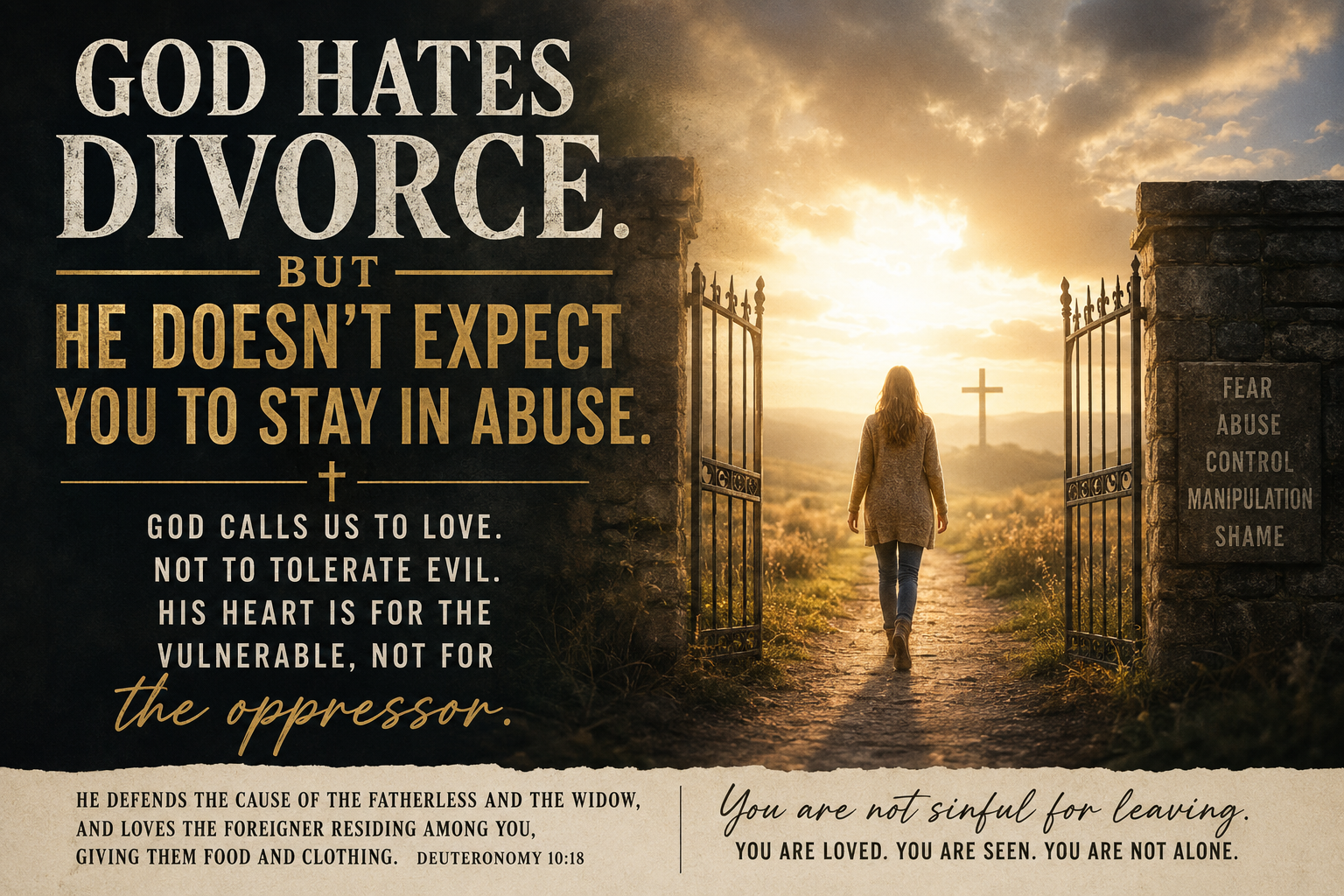
God Hates Divorce. But Does He Expect You to Stay in Abuse?
Let’s start with an uncomfortable truth:
There are people sitting in churches every Sunday secretly living in hell.
Not metaphorical hell.
I mean real hell.
The kind where your stomach knots up when you hear the garage door open.
The kind where every text message feels like a threat.
The kind where you get screamed at, manipulated, controlled, isolated, humiliated, hit, falsely accused, financially trapped, spiritually twisted, or psychologically broken by the very person who once promised to love and protect you.
And then—because life apparently enjoys irony—you finally work up the courage to ask for help and somebody says:
“Well… God hates divorce.”
As if that settles it.
As if the conversation is over.
As if God’s hatred of divorce somehow means He endorses terror.
Let me say this plainly:
No. He does not.
And frankly, the church needs to stop acting like abuse is somehow holier than divorce.
Because here’s the thing nobody wants to admit:
God may hate divorce, but He also hates oppression.
And the Bible speaks a whole lot more about protecting the vulnerable than it does about trapping them inside abuse.
The Problem Nobody Wants to Talk About
A lot of Christians know just enough Bible to become dangerous.
They know verses.
They don’t know context.
They know slogans.
They don’t know theology.
So they hear:
“What God has joined together, let no man separate.”
— Matthew 19:6
And somehow interpret that to mean:
“Stay and let somebody destroy you emotionally, physically, psychologically, or spiritually.”
That is not what Jesus said.
Not even close.
Marriage matters deeply to God because marriage is covenant.
It reflects Christ and the Church.
It’s sacred.
It’s supposed to look like sacrifice, protection, faithfulness, gentleness, forgiveness, and mutual submission under God.
Marriage is not:
intimidation,
manipulation,
fear,
coercion,
control,
violence,
humiliation,
domination.
Marriage is not coming home from work every day and being interrogated like you’re on trial for every conversation, every minute, every interaction, every detail of your day.
Marriage is not walking through your front door wondering what accusation is waiting for you tonight.
It is not living under constant suspicion.
It is not emotional exhaustion so deep that you find yourself praying—not for happiness, not for romance, not even for peace long-term—but simply:
“God… please let me have one night.”
One night without accusations.
One night without torment.
One night without arguing.
One night without harassment.
One night where home actually feels like home instead of emotional warfare.
Because marriage was never meant to feel like surviving an interrogation room.
Marriage was meant to be refuge.
A place of safety.
A place where burdens are shared—not multiplied.
A place where grace exists, trust exists, and love does not weaponize fear.
That’s not covenant.
That’s captivity.
And God has never been in the business of sanctifying captivity.
“But God Hates Divorce…”
Yes.
He does.
That verse comes from:
“For I hate divorce,” says the Lord God of Israel.
— Malachi 2:16
But almost nobody reads the rest of the passage.
You know what God is condemning there?
Men abandoning and betraying their wives.
Men dealing treacherously with the covenant of marriage.
God wasn’t rebuking victims.
He was rebuking covenant-breakers.
Read that again.
The anger of God in Malachi is aimed at the spouse destroying the marriage—not the wounded person trying to survive it.
That changes the whole conversation.
Abuse Is Covenant Breaking
Here’s where people get uncomfortable.
The Bible explicitly permits divorce in certain situations.
1. Sexual Immorality
Jesus gives an exception for adultery.
“Whoever divorces his wife, except for sexual immorality…”
— Matthew 19:9
2. Abandonment
Paul addresses abandonment in:
1 Corinthians 7:15
“If the unbelieving partner separates, let it be so. In such cases the brother or sister is not enslaved.”
Notice that phrase:
not enslaved.
That matters.
Because abuse is abandonment. Read that again. She can sleep next to you day in and day out. But if she’s not loving you the way God commands her to love you. She has abandoned you.
Somebody can sleep in the same bed and still abandon the covenant.
You can share a house with someone who has emotionally left years ago.
A spouse who terrorizes, manipulates, controls, threatens, degrades, assaults, isolates, or weaponizes fear has abandoned the purpose of marriage.
They didn’t just break trust.
They broke covenant.
Because marriage isn’t merely physical proximity.
Marriage is protection.
Love.
Safety.
Faithfulness.
Care.
Sacrifice.
A covenant can die long before the paperwork catches up.
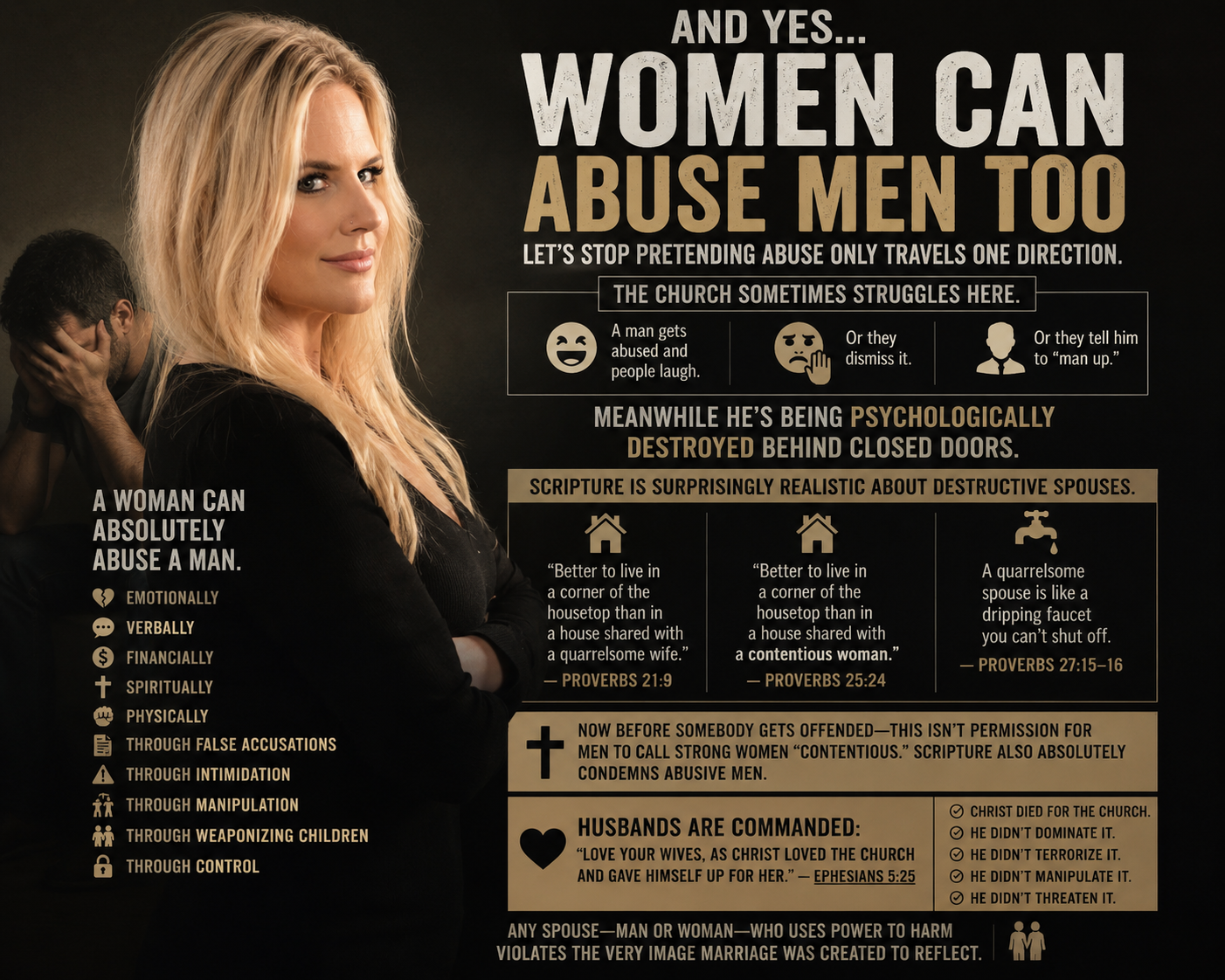
And Yes… Women Can Abuse Men Too
Let’s stop pretending abuse only travels one direction.
The church sometimes struggles here.
A man gets abused and people laugh.
Or they dismiss it.
Or they tell him to “man up.”
Meanwhile he’s being psychologically destroyed behind closed doors.
A woman can absolutely abuse a man.
Emotionally.
Verbally.
Financially.
Spiritually.
Physically.
Through false accusations.
Through intimidation.
Through manipulation.
Through weaponizing children.
Through control.
And Scripture is surprisingly realistic about destructive spouses.
The book of Proverbs says:
“Better to live in a corner of the housetop than in a house shared with a quarrelsome wife.”
— Proverbs 21:9
And again:
“Better to live in a corner of the housetop than in a house shared with a contentious woman.”
— Proverbs 25:24
Then Solomon basically says:
A quarrelsome spouse is like a dripping faucet you can’t shut off.
— Proverbs 27:15–16
Now before somebody gets offended—
This isn’t permission for men to call strong women “contentious.”
Scripture also absolutely condemns abusive men.
Husbands are commanded:
“Love your wives, as Christ loved the church and gave himself up for her.”
— Ephesians 5:25
Christ died for the Church.
He didn’t dominate it.
He didn’t terrorize it.
He didn’t manipulate it.
He didn’t threaten it.
Any spouse—man or woman—who uses power to harm violates the very image marriage was created to reflect.
The Lie Abusers Love to Tell
Abusers love Bible verses.
Not because they love Scripture.
Because they love leverage.
They say things like:
“God hates divorce.”
“Submit.”
“Forgive.”
“God wants reconciliation.”
What they conveniently forget:
God never commands reconciliation without repentance.
And forgiveness is not permission for continued harm.
You can forgive someone and still leave.
You can love someone and still establish boundaries.
You can pray for someone and still protect yourself.
Jesus literally told people to flee danger.
“Then let those who are in Judea flee to the mountains.”
— Matthew 24:16
Why?
Because wisdom sometimes means leaving.
Running from danger is not rebellion against God.
Sometimes it’s obedience.
Churches Need to Stop Protecting Wolves
Let me say something hard:
Some churches have done unbelievable damage here.
They protect appearances.
They protect marriages on paper.
They protect abusers.
Meanwhile the victim quietly breaks.
And if they leave?
They get judged.
Gossiped about.
Disciplined.
Treated like the sinner.
That is spiritual malpractice.
The church’s job is not to preserve the illusion of marriage.
The church’s job is to protect people and uphold truth.
Jesus consistently moved toward the vulnerable.
Not toward image management.
If your theology forces somebody to stay in danger—
your theology is broken.
So Is Divorce for Abuse Sin?
Here’s my conclusion.
No.
Not for the abused spouse.
Sin already entered the marriage.
The covenant was already shattered.
The abuse already violated what God intended.
Sometimes divorce isn’t destroying something sacred.
Sometimes it’s acknowledging that something sacred has already been destroyed.
And if divorce occurs because one spouse shattered covenant through abuse—
I do not believe Scripture condemns the innocent spouse for remarrying.
Because they were not the covenant-breaker.
The abuser was.
One Last Thing
If this is you—
If you’re scared.
Confused.
Ashamed.
Questioning yourself.
Wondering if God is disappointed in you because you’re trying to survive—
hear me carefully:
God is not asking you to volunteer as a martyr to someone else’s sin.
He sees you.
He cares.
He protects the vulnerable.
And sometimes the holiest thing a person can do…
is leave what evil has already destroyed.
Because yes—
“What God has joined together, let no man separate.”
Amen.
But we should also stop pretending God expects people to stay chained to what sin has already torn apart.
-Ryder Knox