
The New Human
Comfort Is Creating a Weak Society
Something is happening to us.
Not politically.
Not economically.
Not technologically.
Humanly.
There’s a different kind of person being developed right in front of us, and most people are too distracted, too afraid, or too conditioned themselves to admit it.
We are raising a generation addicted to comfort.
And comfort, unchecked, is one of the most dangerous addictions a society can have.
Because comfort weakens people.
You can see it everywhere now. People quit faster. Fold easier. Blame more. Endure less. Responsibility has become offensive. Accountability feels like oppression. Discipline is treated like trauma. And struggle — the very thing that once built strong men and women — is now viewed as something children should be protected from at all costs.
That mindset is a disaster waiting to happen.
Human beings were not designed to grow through comfort. They grow through resistance.
Muscle only grows through stress. Character only grows through adversity. Confidence only grows when you survive something difficult and realize you’re stronger than you thought.
But we’ve removed difficulty from development and now act confused when resilience disappears.
Research actually supports this.
Neuroscientists have repeatedly found that the prefrontal cortex — the area responsible for impulse control, long-term thinking, judgment, and emotional regulation — is not fully developed until roughly the mid-20s in most males and early 20s in females. Yet modern parenting culture increasingly encourages children and teenagers to make major life decisions based on feelings, comfort, and preference.
In other words, we are handing adult freedoms to minds that are still neurologically wired for impulsivity, emotional reactivity, and instant gratification.
And then we wonder why discipline is collapsing.
A child’s natural instinct is not to choose what is best long term.
It’s to choose what feels easiest right now.
That’s human nature.
That’s why parents are supposed to lead.
But leadership has slowly been replaced with negotiation.
Correction has been replaced with validation.
Authority has been replaced with “Well, what do you want to do?”
And now we have kids growing up believing discomfort itself is unhealthy.
That’s catastrophic.
Because life does not care about your comfort.
The real world does not hand out trophies for potential, intentions, feelings, or self-expression. Eventually every human being collides with hardship. Failure. Rejection. Pressure. Loss. Competition. Exhaustion. Consequences.
And if they never learned resilience while young, adulthood hits them like a truck.
Studies from organizations like the American Psychological Association have shown rising levels of anxiety, avoidance behaviors, and emotional fragility among younger generations. At the same time, researchers continue finding strong correlations between resilience, structured expectations, delayed gratification, and long-term life success.
In plain English?
The ability to suffer through hard things matters.
A lot.
But somewhere along the way, suffering became the enemy instead of the teacher.
Now we normalize quitting.
If something is hard, walk away.
If someone corrects you, you’re being attacked.
If commitment becomes uncomfortable, leave.
If accountability hurts your feelings, call it toxic.
That mentality does not create freedom.
It creates weakness disguised as self-care.
And weak people are dangerous — not because they’re evil, but because they collapse under pressure.
A society full of people who cannot handle discomfort becomes emotionally unstable, easily manipulated, addicted to distraction, and incapable of sacrifice.
That’s not strength.
That’s decay.
The truth is, most people become who they are because someone forced them to push through something difficult.
The coach who wouldn’t let them quit.
The father who said, “You made a commitment. Finish it.”
The mother who held standards.
The mentor who demanded more.
The difficult season that taught them discipline.
The failure that humbled them.
The rejection that sharpened them.
Those moments forged identity.
Not comfort.
Not convenience.
Not unlimited freedom without structure.
And this is where modern culture is getting it dangerously wrong.
Children do not need parents who act like consultants.
They need leaders.
They need standards.
They need accountability.
They need someone strong enough to withstand being temporarily disliked in order to help them become stronger human beings later.
Because when children are raised believing life should constantly adjust itself around their feelings, they eventually become adults who cannot function once reality refuses to cooperate.
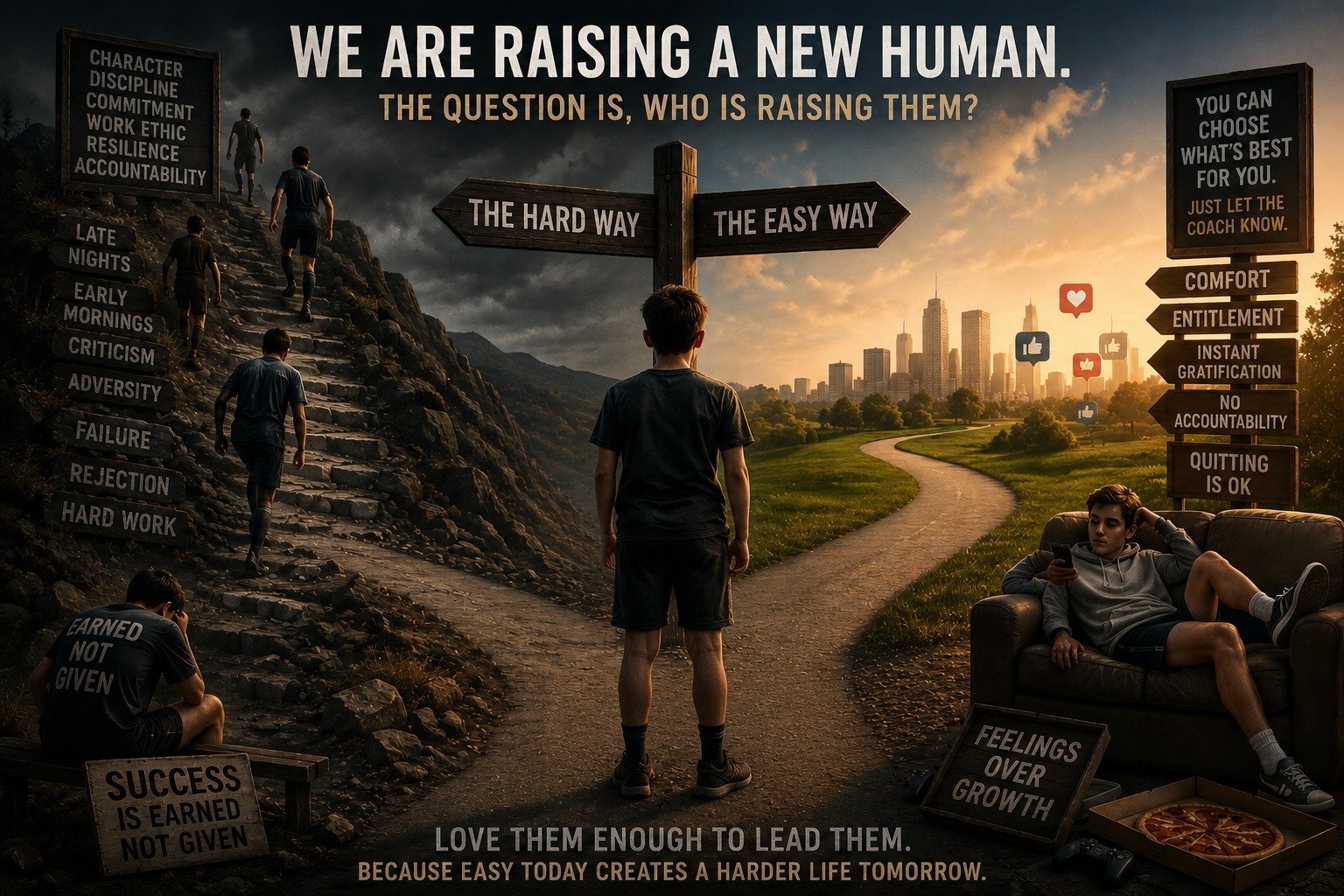
That is the “new human” being developed right now.
Emotionally fragile.
Comfort addicted.
Avoidant.
Entitled.
Unable to endure hardship.
Constantly seeking escape routes instead of growth.
And if we continue down this road, we are not creating a stronger society.
We are creating one that breaks the second real adversity arrives.
The scary part?
Most people cheering this on think they’re helping.
But love is not removing every obstacle from a child’s path.
Love is preparing them to survive the obstacles life guarantees are coming.
That means discipline.
That means structure.
That means accountability.
That means teaching them to do hard things even when they don’t want to.
Because strength is built through resistance.
Always has been.
Always will be.
And if we don’t wake up soon, this “new human” we are creating won’t just struggle personally.
They will struggle to hold together families, communities, workplaces, relationships, and eventually society itself.
Because civilizations do not collapse when people become too strong.
They collapse when people become too soft.
— Ryder Knox