
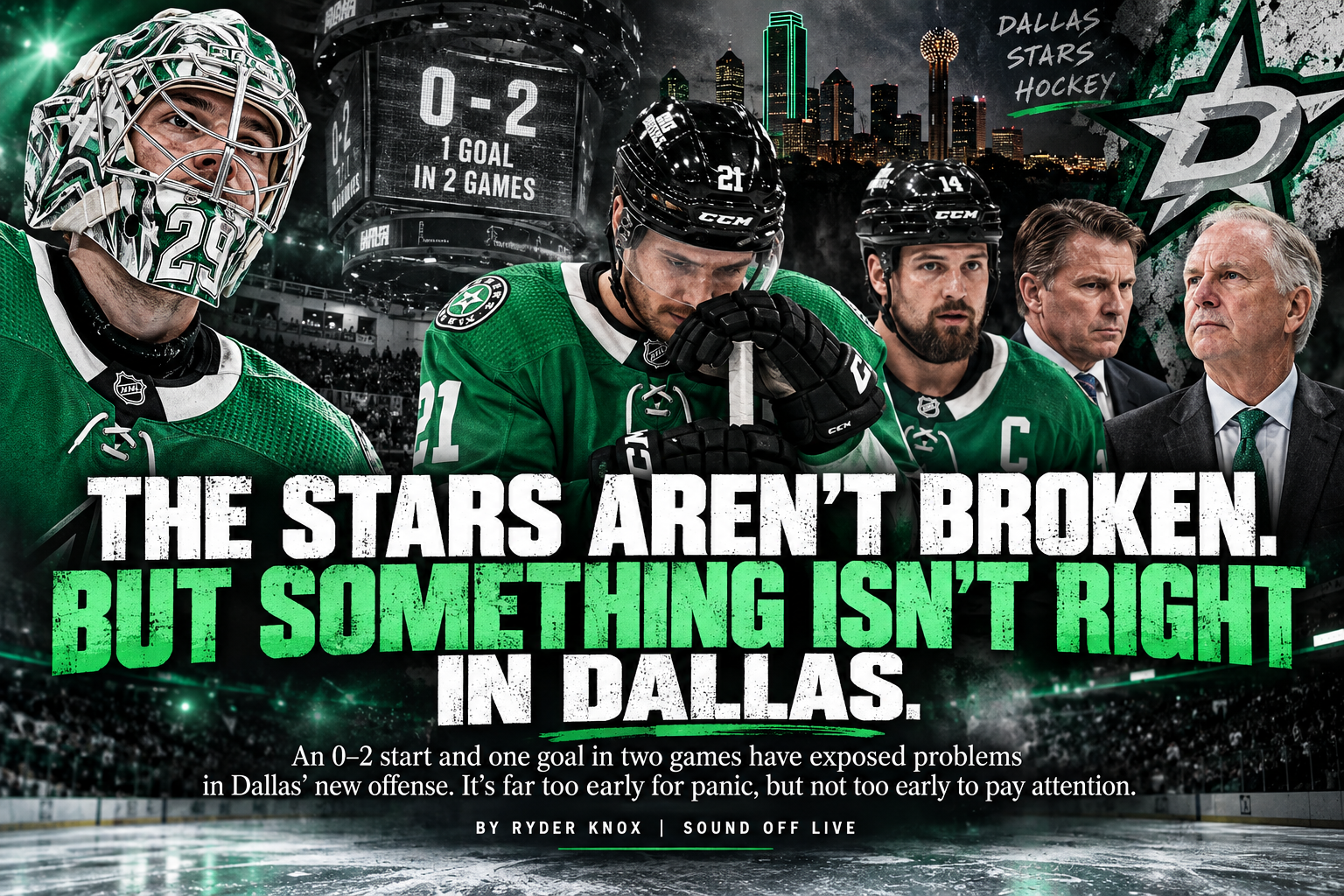
The Stars Aren’t Broken. But Something Isn’t Right in Dallas.
An 0–2 start and one goal in two games have exposed problems in Dallas’ new offense. It’s far too early for panic, but not too early to pay attention.
By Ryder Knox | Sound Off Live
DALLAS — Two games.
That's it.
Two games into an 82-game NHL season, nobody should be reaching for the emergency button. Jim Nill certainly shouldn't be shopping half the roster. Glen Gulutzan shouldn't be ripping apart a system his players have barely begun to learn.
But let's not pretend everything is fine, either.
The Dallas Stars are 0–2.
They have scored one goal.
And for a franchise built to spend another spring chasing the Stanley Cup, the troubling part isn't the record.
It's how they've gotten there.
Dallas opened its season with a 4–0 loss to St. Louis before falling 2–1 to Nashville. That's six goals allowed and one scored through the season's first 120 minutes.
The Stars aren't being betrayed by Jake Oettinger.
They're being betrayed by an offense that, so far, can't get going.
This isn't an Oettinger problem

Start there, because the 4–0 score against St. Louis makes the opener look worse than it actually was.
Two of the Blues' four goals were empty-netters. Oettinger stopped 20 of the 22 shots he faced despite entering the regular season without preseason game action because of a lower-body injury.
Dallas even won 62% of its faceoffs.
It didn't matter.
Possession without production is just possession.
The Stars couldn't consistently turn the puck into dangerous offensive opportunities, and even a nearly three-minute power play following a major penalty went nowhere.
That is the early warning sign.
The Stars aren't simply missing shots.
They're struggling to create them.
A new offense that hasn't clicked
Gulutzan and his staff entered the season emphasizing cleaner breakouts, better puck possession and improved offensive creation.
Through two games, we're still waiting to see it.
Dallas has spent too much time defending because it hasn't consistently moved the puck cleanly out of its own end. Lost battles become failed breakouts. Failed breakouts become more defensive-zone time. More defensive-zone time means fewer opportunities for Dallas' best offensive players to do what they're paid to do.
It's a cycle.
And right now, it's an ugly one.
Jamie Benn pointed toward another part of the problem after the Nashville loss: the Stars' starts haven't been good enough.
That's not a system issue.
That's urgency.
And Benn placed that responsibility where it belongs—on the players.
Losing Matt Duchene matters
There is also an important name missing from the lineup.
Matt Duchene.
Duchene suffered a setback with his lower-body injury and landed on long-term injured reserve, removing an important offensive piece while Dallas is simultaneously attempting to establish a new offensive identity.
Arttu Hyry and Colin Blackwell have been brought into the mix, but replacing a player like Duchene isn't simply a matter of putting another forward in his spot.
His absence changes combinations. It changes matchups. It removes another player capable of creating offense when a game gets stuck in the mud.
And Dallas is currently living in the mud.
So what is Jim Nill doing?
For now?
Not panicking.
And that's probably exactly what Dallas needs from its general manager.
Nill recently committed four years and $14.8 million to Sam Steel and another two years and $5 million to backup goaltender Casey DeSmith. Those aren't the moves of an organization questioning the foundation of its roster.
They're the moves of a franchise that believes in what it has built.
There is another complication, too.
Money.
Dallas doesn't have unlimited salary-cap flexibility, and Gulutzan has acknowledged that finances are affecting some roster decisions. That makes an impulsive early-season trade even less likely.
The Stars need to determine what they actually have before Nill starts trying to fix something.
Two games aren't enough evidence.
Ten or 15 might be.
This is why I'm not panicking
If Dallas were getting dominated defensively every night while Oettinger surrendered soft goal after soft goal, this would be a different conversation.
That's not what's happening.
This team simply cannot score right now.
There's a difference.
A roster with this much offensive talent isn't going to average half a goal per game over any meaningful stretch of the season.
The question isn't whether that number improves.
Of course it will.
The question is what Dallas looks like when it does.
Are the Stars consistently entering the offensive zone with possession?
Are they sustaining pressure rather than getting one opportunity and retreating?
Does the power play begin looking dangerous?
Are Jason Robertson, Roope Hintz and the rest of the top six regularly creating quality chances?
And, maybe most importantly, do the Stars start looking comfortable in Gulutzan's system rather than thinking their way through it?
Those answers matter considerably more right now than an October record.
San Jose is more important than it should be
That's what makes tonight interesting.
San Jose enters at 2–0.
Dallas enters at 0–2.
Nobody inside the Stars' organization should describe Game 3 of an 82-game season as a must-win.
It isn't.
But it might be a must-look-better game.
Because Buffalo and Pittsburgh follow, and then Dallas gets a home-and-home with Colorado.
An 0–2 start can disappear in a week.
An 0–2 start that becomes 1–5 while the same problems persist becomes something else entirely.
That's when Nill's phone should start getting considerably more interesting.
For now, my concern level remains about a 3 out of 10.
No panic.
No emergency trades.
No declaration that a perennial contender suddenly forgot how to play hockey.
But no excuses, either.
The Dallas Stars aren't broken.
They just haven't looked much like the Dallas Stars yet.
And beginning tonight, it's time they did.